+393333275022

---

PRIVACY POLICY

Aristide Gattavecchia

Painter and Sculptor - Italian 20th-century artist

Criticism and Testimonials

Vittorio Sgarbi
The narrators of our time 2024

..."Aristide Gattavecchia lived in Cesena in the same places and in the same years as Alberto Sughi, a painter who was his friend, who died a few years ago, who was a great realist but also existential painter, and Sughi comes to mind because in Gattavecchia's painting there is not a consonance or affinity with Sughi but there is an atmosphere, the idea of a place on earth where one feels the profound dimension of a spirituality that is what the Romagna world expresses in its greatest, warmest representations like that of an artist like Fellini.


Here, the idea of feeling that Romagna in which the fog often hides and recalls that Fellini film with that character who says: "But where have I ended up?" because he no longer recognizes anything around him, "but if this is the afterlife, it's not a nice thing at all!".


That is, the feeling of getting lost in these constant fogs, in these fumes, which are the fumes of places where life no longer exists, have been a reason for deep reflection for Gattavecchia, just as his silhouettes of figures recall the great painting of Sironi, but everything is as if seen in an afterlife, in a hell where it is difficult to find the light.


So his painting is both dramatic and existential.
 In this, it must be said that the references I made are the references that serve to make it felt that he was not alone in this condition of existential discomfort.


He was able to leave us very important signs of his human relationship, in portraits such as "La Bruna" from 1960, which is a remarkable portrait of great strength and in some landscapes in which the nudes are headless like classical sculptures, ancient sculptures.


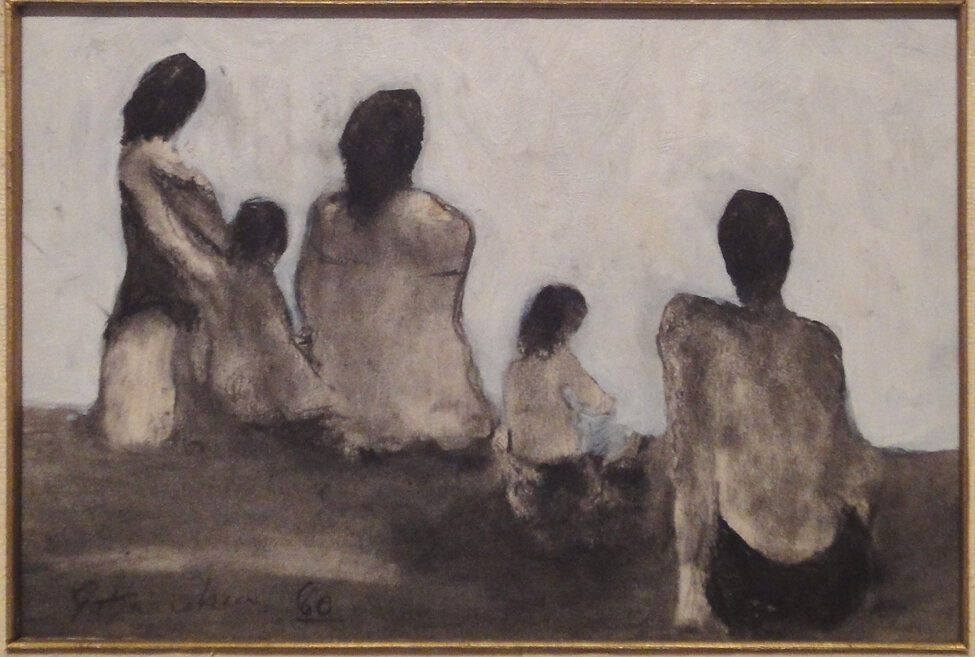
It is something that has to do with the feeling of a world that no longer has a certain reference, and there are no longer any secure values and everything, even families at the seaside, are seen from behind as if to represent a condition of unhappiness and inadequacy.


Here, among his significant works, there is certainly this foggy landscape of a ghostly Cesena, which becomes like a place of the afterlife.


His faithfulness to his lands does not, however, make him a vernacular artist who tells of Romagna as a picturesque fact, but as something in which there is the profound sense of a dramatic existence, which was his, with the themes of the landscape that are so much talked about today.


Of the climate therefore the pollution, the dimension of the end of a certainty of a harmonious world, and all this is in this representation of his so intensely dramatic that it wants to make us reflect even today (he died in 1994) on a crisis of the world in which one feels a profound discomfort.


 Then the faces like that of this wonderful female figure, "La Bruna", give us the sense that humanity resists but that around us there is a collapse of the world, there is a nature that is less and less happy and we must somehow try to defend ourselves by staying close, being close to each other, to avoid being overwhelmed.


Here, this hope in the end, in his tendentially pessimistic vision, is a significant sign of the legacy that Gattavecchia leaves us with his painting."


Prof. Vittorio Sgarbi

ca8ef440-0836-488e-97b0-dc2b06ff09e6

The testimony of his friend Alberto Sughi

In 1987, the Municipality of Cesena decided to celebrate Gattavecchia's 80th birthday by organizing a solo exhibition for him at the Municipal Art Gallery.

The famous artist Alberto Sughi was supposed to attend the event to pay tribute to him, given their great friendship.

Unfortunately, he was unable to be present, but he tried to show his closeness by sending him the "rough draft" of the speech he would have given at the inauguration.

This is an interesting testimony to the cultural and artistic ferment of that period and to how many artists shared emotions, dialogue, and debate, all gathering together in the studio at the top of the tower, in the historic Rocca of Cesena.

8a8c92e2-bf07-4321-a5b3-8400b28ee3c0

The letter from Alberto Sughi

Dear Aristide,
Do you remember how many of us found ourselves laughing, crying, and dreaming like children in that liberating postwar period?

I like to recall the dear names, just as they resurface from that distant time, and I begin with yours, Aristide, who today reaches 80 years with the gaze and heart of a young man and with that of the unforgettable Otello Magnani, like you nourished by intelligence and a tenacious passion for painting.
And the names of the inseparable trio Cappelli, Caldari, and mine.
Perched in the fortress above the square together with Fioravanti, architect and sculptor, and the young professor Dradi who, for the first time, tried to critically identify our work.
How many endless hours spent together in the streets, in the cafés of old Cesena discussing everything: art, politics, life... and how vivid is the memory of you, Aristide, acrobatic imp of paradox, always on the wire that links reality and fantasy.
In those years, first the great Muccini and then the poet Pedretti arrived in Cesena, who have left us, as if they wanted to entrust to our group the example and memory of the character of artists and intellectuals.

I must confess to you, Aristide, my emotion in recalling that season: everything seemed to move along a path derailed by who knows whom... back then we liked to think that on that path there were still traces of the footsteps of Renato Serra.

How wonderful it would be to return to the Rocca studio in a sort of metaphysical room where we could resume our conversations, perhaps together with the friends who came to visit us from afar like Raimondi, Bernari, Guerra, Cagli, and all the writers and scholars who made their way up there through Giovanni Bettini's bookshop.

Dear Zimildin, I am glad that the Cesena administration is organizing an exhibition to celebrate your incredible 80 years.

Whoever visits your exhibition will understand how deep was the cultural commitment that animated our group and how your painting is nourished by that original stylistic character that made more than one person think of the birth of the Cesena school.

On other occasions I have spoken more specifically about your work; allow me today, as I am far away, to let memory revive the outlines of a distant season in which your person and your work also played such an important part.
Many affectionate wishes from your  Alberto Sughi
Rome, 9/11/1987

2362f76a-9a76-440a-8780-60591b7251ab

Gattavecchia with friends Gino Lucchi, Alberto Sughi and Silvano Barducci

Gattavecchia with friends Gino Lucchi, Alberto Sughi and Silvano Barducci

ca8ef440-0836-488e-97b0-dc2b06ff09e6
87fdb9af-82f0-47d0-9d45-e6cb0ed9a2c9

Aristide Gattavecchia

"Art is freedom and communicative power"

instagram

PRIVACY POLICY